
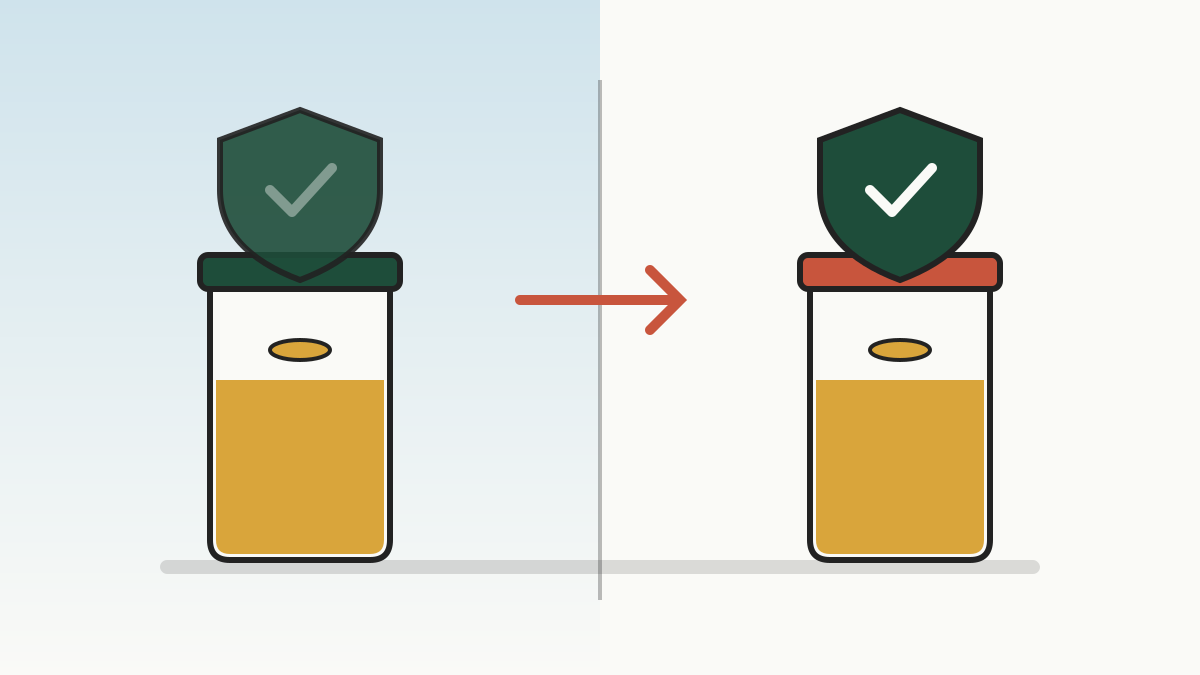
The core difference between traditional and Roth retirement accounts is when you pay income tax. With a traditional account, contributions are often made before tax and withdrawals are taxed later; with a Roth account, contributions are made with after-tax money and qualified withdrawals can come out tax-free. Which one works better depends largely on how your tax rate today compares with your tax rate in retirement.
How each account is taxed
Both types exist in workplace plans such as 401(k)s and in individual retirement accounts (IRAs). The investment options inside can be identical. What changes is the tax treatment at each stage.
| Stage | Traditional | Roth |
|---|---|---|
| Contribution | Often pre-tax or deductible | After-tax, no deduction |
| Growth | Tax-deferred | Tax-free if rules are met |
| Qualified withdrawal | Taxed as ordinary income | Generally tax-free |
Each type comes with its own rules on eligibility, income limits, early withdrawals, and required distributions. Those rules are set by law and change over time, so confirm current details with official IRS guidance and your plan documents.
A side-by-side illustration
This is a simplified illustration with hypothetical, round numbers. It ignores fees, investment losses, and the many rules that apply in real life.
Imagine you have $1,000 of pre-tax income to save, and you assume a flat 20% tax rate both now and in retirement. Assume the investment doubles before you withdraw it.
- Traditional: you invest the full $1,000. It grows to $2,000. At withdrawal, 20% tax is $400, leaving $1,600.
- Roth: you pay 20% tax first, leaving $800 to invest. It grows to $1,600. The qualified withdrawal is tax-free, leaving $1,600.
With identical tax rates, the outcomes match. Now change one assumption: if your rate in retirement were 10% instead of 20%, the traditional account would leave $2,000 minus $200, or $1,800, beating the Roth. If your retirement rate were 30%, the traditional account would leave $2,000 minus $600, or $1,400, and the Roth would come out ahead. The comparison really turns on tax rates, not on which account “grows faster.”
Factors people weigh
Expected future income
Someone early in a career with modest earnings may expect a higher tax bracket later and lean toward Roth. Someone at peak earnings may value the immediate deduction of a traditional account. Neither expectation is certain, because future income and future tax law are both unknown.
Flexibility and diversification
Holding money in both types, sometimes called tax diversification, can give you more choices later about which account to draw from in a given year. This approach does not require predicting tax rates precisely.
Current cash flow
Because a traditional contribution may lower your current taxable income, the same paycheck deduction can feel smaller. A Roth contribution of the same size costs more today in take-home pay.
Employer contributions
In many workplace plans, employer matching contributions have historically gone into the traditional side even when you choose Roth for your own money. Some plans now offer other options. Check how your plan handles this.
Key takeaways
- Traditional means tax later; Roth means tax now.
- If tax rates stay the same, the two can produce the same after-tax result.
- Eligibility, income limits, and withdrawal rules differ and change over time.
- Splitting contributions between both types is a common way to handle uncertainty.
- Investment returns are never guaranteed, and account values can decline.
Choosing between traditional and Roth is less about picking a winner and more about deciding when you would rather pay tax. By estimating your situation now, considering a range of possible futures, and reviewing the current rules for each account type, you can make a choice that fits your own circumstances, and revisit it as your income and the law evolve.