
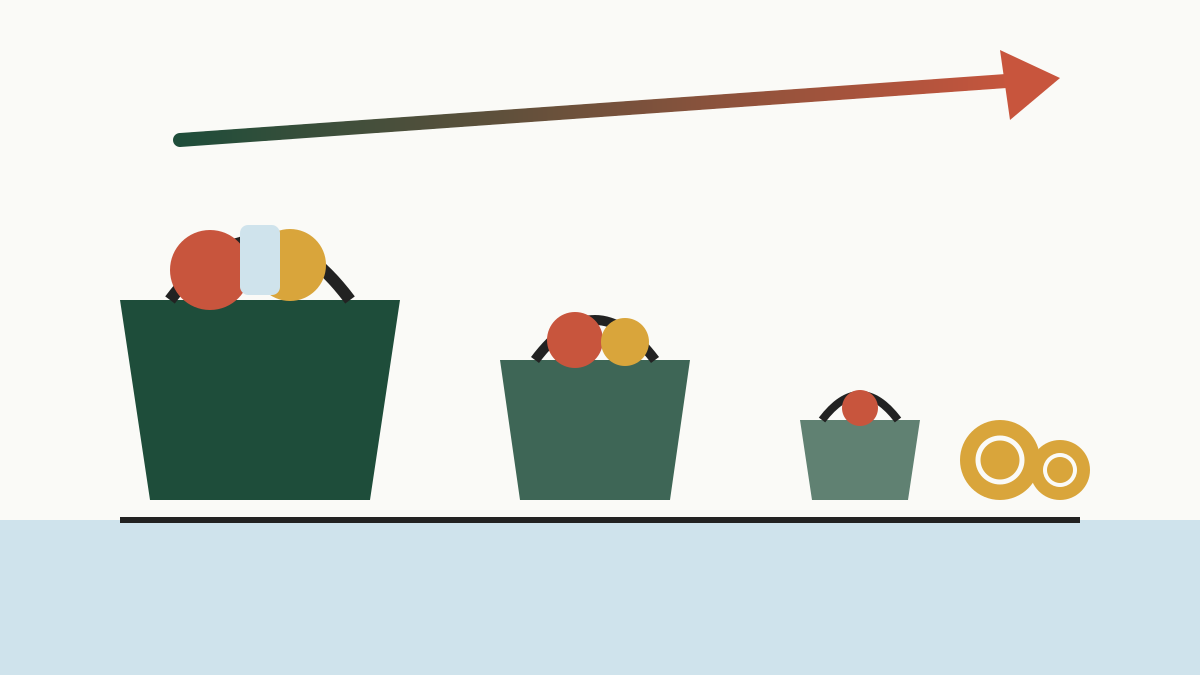
Picture a twenty-dollar bill tucked in a drawer for ten years. It still says twenty dollars when you pull it out, but it probably buys noticeably less than it did when you put it away. That gap is inflation at work: a general rise in prices that reduces how much each dollar can purchase.
What Purchasing Power Means
Purchasing power is the quantity of goods and services a given amount of money can buy. When prices rise across the economy, the same income or savings covers fewer groceries, fewer tanks of fuel, and fewer months of rent. Your balance does not shrink on paper, but its real value does.
Inflation is usually measured with a price index that tracks the cost of a typical basket of goods and services over time. Different countries use different methods, and the rate itself changes from year to year. Some years see very little inflation, while others see much faster price growth. Because of that, it helps to understand the mechanics rather than focus on any single figure.
How Rising Prices Add Up
Inflation compounds, much like interest. A price that rises by a certain percentage this year rises from that new, higher level next year. Over a long stretch, even a modest annual rate can make a meaningful difference in what things cost.
A worked example
Illustration with round, hypothetical numbers: Suppose a basket of groceries costs $100 today and prices rise 5% per year.
| Year | Cost of the same basket |
|---|---|
| Today | $100.00 |
| After 1 year | $105.00 |
| After 2 years | $110.25 |
| After 3 years | $115.76 |
Now look at it from the other side. If you kept $100 in cash for those three years, it would cover only about 86% of the basket, because $100 ÷ $115.76 is roughly 0.86. The money did not disappear, but its purchasing power fell by about 14% in this hypothetical case.
Effects on Savings and Income
Cash held in a place that earns little or no interest loses real value whenever inflation is above zero. Savings that earn interest fare better, and a useful way to judge them is the real return: roughly the interest rate minus the inflation rate. If an account paid 3% while prices rose 5%, the real return would be about negative 2%, meaning the balance grows in dollars while still buying slightly less each year.
Wages work the same way. A raise looks good on a paycheck, but if prices rose faster than your pay, your real income actually declined. Comparing raises against the general rise in prices gives a clearer picture of whether your standard of living is moving forward.
Debt and fixed payments
Inflation can cut the other way for fixed-rate debt. A loan payment that stays the same in dollars takes up a smaller share of a budget if incomes rise with prices. Variable-rate debt is different, since its interest rate may climb when overall rates rise.
Ways People Adapt
There is no way to opt out of inflation, but people commonly respond in a few practical ways:
- Reviewing a budget regularly, since last year’s numbers may no longer fit.
- Comparing savings options by their real return, not just the stated rate.
- Keeping an emergency fund accessible while recognizing that idle cash slowly loses value.
- Learning how long-term goals, such as retirement, account for rising costs.
Key Takeaways
- Inflation reduces what each dollar buys, even when the balance stays the same.
- Price increases compound, so small annual rates add up over many years.
- Real return equals roughly the interest rate minus inflation.
- Rates vary by country and change over time, so check current official figures when planning.
Thinking in terms of purchasing power, rather than raw dollar amounts, makes financial decisions easier to judge. Once you start asking what money will actually buy in the future, savings rates, raises, and long-term plans all come into sharper focus.