
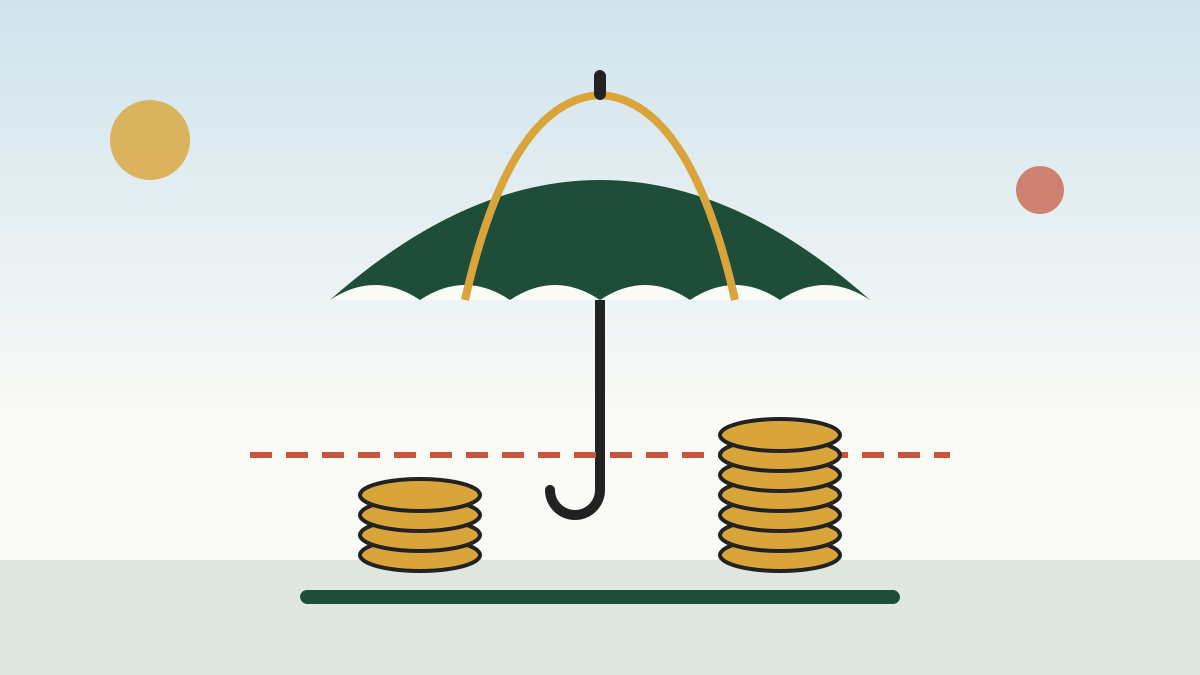
A deductible is the amount you agree to pay toward a covered loss before your insurance company starts paying. If a claim is smaller than your deductible, you usually pay the whole thing yourself. If it is larger, the insurer covers the rest, up to your policy limits.
The basic idea behind a deductible
Insurance is designed to protect you from costs that would be hard to absorb on your own. Deductibles keep small, routine expenses with the policyholder, which reduces the number of minor claims an insurer has to process. In exchange for taking on that first slice of risk, you generally pay a lower premium than you would with a smaller deductible.
Deductibles show up in many types of coverage, including auto, homeowners, renters, and health insurance. The details differ from one policy to the next, so the only reliable source for how yours works is the policy document itself.
Per-claim versus annual deductibles
Not every deductible resets the same way. The two most common structures are:
- Per-claim (or per-occurrence) deductibles. These are common in auto and property insurance. You pay the deductible each time you file a separate claim, so two unrelated incidents in one year can mean paying it twice.
- Annual deductibles. These are typical in health insurance. Once you have paid a set amount during the plan year, the deductible is met, and cost sharing changes for the rest of that year.
Some property policies also use percentage deductibles for certain perils, such as wind or hail. Instead of a flat dollar figure, the deductible equals a percentage of the home’s insured value. A small percentage of a large dwelling limit can add up to a surprisingly large out-of-pocket amount, so it pays to check whether your policy includes one.
A worked example
Illustration only; the numbers are hypothetical. Suppose your car policy has a $1,000 collision deductible, and you have an accident that causes $4,500 in covered damage.
| Item | Amount |
|---|---|
| Total covered repair cost | $4,500 |
| Your deductible | $1,000 |
| Amount the insurer pays | $3,500 |
Now imagine a different incident with $700 in damage. Because $700 is below the $1,000 deductible, the insurer would pay nothing, and filing a claim would not help you financially. Many people simply pay for repairs like this directly.
How deductibles affect your premium
There is a trade-off between the deductible and the premium. A higher deductible usually lowers your regular payments, because you are agreeing to handle more of each loss. A lower deductible raises premiums, because the insurer expects to pay more often and more per claim.
Consider a hypothetical comparison. Policy A has a $500 deductible and costs $1,200 a year. Policy B has a $1,500 deductible and costs $900 a year. Policy B saves $300 a year in premiums, but you would pay $1,000 more out of pocket on any claim. If you went roughly three or more years without a claim, the premium savings would cover that gap. If you filed a claim in the first year, Policy A would have cost less overall. Actual price differences vary by insurer, location, and coverage, so run this math with real quotes.
Choosing a deductible level
A practical starting point is your savings. A deductible only works for you if you can pay it on short notice without borrowing or falling behind on bills. Beyond that, think about how often you are likely to file claims and how much the premium actually changes between deductible options.
Common mistakes
- Choosing a deductible higher than your emergency savings can cover.
- Assuming every deductible is annual when some reset with each claim.
- Overlooking separate deductibles for specific perils, such as wind or hail.
- Filing small claims that barely exceed the deductible without weighing the possible effect on future premiums.
A deductible is simply your share of the risk, and the right level depends on balancing lower premiums against the cash you can comfortably set aside. Read the declarations page and policy wording carefully, note how and when each deductible applies, and compare the total cost of a few options before deciding.